
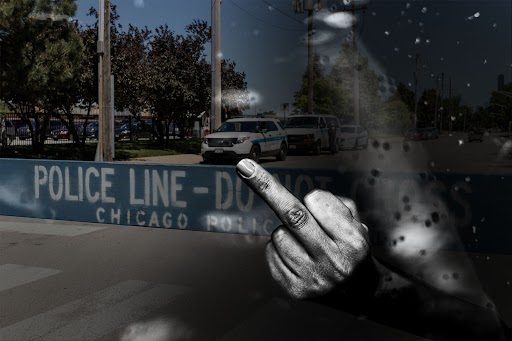
All Five Fingers
Lessons from a game of cops and robbers in Englewood.
“ . . . pummeling and stomping the kid on the bottom of the pile, curled up into a fetal position. His hands covering his head as best as he could.”
I came to Chicago by way of Minnesota, far south-suburban Minneapolis to be exact. One could say that I brought a certain level of naivety with me, even though I worked in Minneapolis in a residential security setting that had a large diverse population in both race and economic status.
We had regular contact with the Minneapolis Police Department, and everyone I worked with wanted to be a cop. But I was a fifth-year art major studying oil painting being compared in style with Edvard Munch and Emil Nolde, in style, mind you, not talent.
When I decided I wanted to be a cop too, I was disappointed to I learn that I would have to go to school for another two years to attain the necessary two-year certificate to be able to apply for jobs in Minnesota. Only one class of my nearly five years of classes, and as many majors, at the University of Minnesota would count towards what was essentially a very specialized associate degree. That is in no way trying to disparage the educational requirements to be a cop, but to highlight my frustration.
So, I looked elsewhere.
Which led me to Chicago. I took the test with over 36,000 people in 1985 and was fortunate to get in the second class that summer of 1986, July to be specific, 14 JUL 1986 to be exact.
I got out in November and was assigned to the 007th District, Englewood, on the south side. Arguably one of the fastest districts in the city, consistently in the picture for highest crime rate and number of murders every year. It was only twenty city blocks by twenty city blocks. From the Dan Ryan expressway on the east, to about Hoyne Avenue on the west. From Garfield Boulevard (55th Street) on the north to 75th Street on the south end.
My education was swift.
I’ve read policing referred to as an occupation force in the late ’80s & ’90s. In 1986, in retrospect, I can see why someone might say that—the police, district police and specialized units were everywhere. I know I spoke to a lot of people who really appreciated the police, though it was usually said covertly, unfortunately. One could argue the community was also being held hostage by the gangs. It was a war zone, at least in Englewood and many other places in the city as well.
A good illustration of this happened in the summer of 1987.
It was hot.
We rotated shifts back then, but I think it was early on the afternoon shift, when we were rolling down a side street and encountered a group of boys fighting. These were pre-teenagers, and they were play-fighting, well at least the bunch who were standing, pummeling and stomping the kid on the bottom of the pile, curled up into a fetal position. His hands covering his head as best as he could.
I was in the passenger seat of the marked Chevy, my partner that day, and I don’t remember who, slowed as I looked out of the open window. While I wasn’t worried about the kid on the ground, I don’t think he was getting hurt, he still looked a little scared.
The kids were laughing, hollering and yelling. As we rolled to a stop adjacent to their scrum on the parkway, their punching and kicking slowed and finally came to a stop as our squad car did.
“Hey,” I said, “what ya doing?”
One of the larger kids in the back said, “We playin’ cops and robbers.”
My thoughts flashed to the innumerable foot chases these kids must’ve seen in their short lives living in the heart of the drug trade. And how, in some way, their play was emulating the action out on the street, at least as they’d heard it told, or seen firsthand. I could see cops chasing bad guys through the yards, tackling their quarry and the struggle that followed to get the handcuffs on.
I could only imagine all of the fights they’ve seen, gang fights, and everything other kind of fight under the sun. Sadly, violence was a way of life on the streets of Englewood. How had that affected these kids?
“What’d he do?” I asked. A smile on my face, their having fun was contagious. “The robber.” I nodded toward the kid on the ground who was using the break to catch his breath. I was curious what constituted an ass whooping in the minds of these kids. What imaginary transgression had this boy committed?
“What’d he do?” I asked again.
“He the cop!”
With a loud hoot, the knot of boys commenced to thumping and pounding the unlucky kid on the ground. I felt my partner lift his foot from the brake of the box Chevy which started to roll down the street.
I had my answer.
As we made our escape, some of the boys were holding their sides from laughing. As we made the end of the block, there must’ve been enough of a distraction that the “cop” was able to make a break and run from the other boys who launched after him in their own foot pursuit.
And that is why I really appreciate the community I work in today. The blue collar, well- balanced community of Bridgeview, where the full five-fingered wave is the rule, not the exception.
Stay Connected with Stories That Matter
Get firsthand reflections from retired officer and author Dave Case — powerful, personal stories from behind the badge, straight to your inbox!